“Poppy, you won’t believe what happened to me yesterday where I was carving my AI. I asked the Chat GPT which office it's proposing to me for the services I provide in my area and it took out a list of invalidities, except for me. And not only that, when I mentioned the name of my office, he wrote with great confidence that he belongs to someone else.”
I let the earpiece rest in its place while thoughts began to swirl in my mind. The time had arrived: my clients had not only included artificial intelligence in their daily lives, but now they demanded the vindication of their existence within its digital world.
It's time to have the conversation GEO, AEO, or how AI will suggest you in its answers.
Let's unravel the thread from the beginning.
What is Artificial Intelligence and How Does It Work?
“Artificial Intelligence” could be described as a sophisticated mirror of human knowledge. At its heart are the Large Language Models (LLMs) that we now use daily (ChatGPT, Gemini, Claude, etc.), which instead of following predetermined commands, have been "trained" by studying countless texts from every corner of the internet.
Imagine that artificial intelligence works like a digital reader who has absorbed billions of pages and has learned to recognize the patterns of our language. When you ask a question, it does not "think" in our own way; on the contrary, it calculates with tremendous speed the chances to compose an answer that makes sense, word for word. Essentially, it is a powerful information-processing mechanism that bridges the gap between dry data and human communication, offering us solutions in seconds.
Those LLMS are basically:
“GEO” is the new SEO: The science behind the screen
If until today the keyword for search engine visibility was SEO, it is time to add a new letter to your vocabulary: GEO (Generative Engine Optimization). This is not just some new internet "trick," but an official scientific term born in the labs of top universities, such as Princeton and IIT Delhi.
In a recent,innovative study, the researchers demonstrated what we all suspected: the way ChatGPT, Perplexity and Bing choose which businesses to recommend, is somewhat different from the one we knew.
The main difference between GEO and SEO
Previously (1998-2024), our goal was Click. We wanted the user to enter our site. Today, our goal is Mention to these models. Even if the customer never visits your website, the fact that AI told him: "X's office is the best choice for your area," has already built you the authority you need.
So organic Google search is not enough anymore?
For decades, we’ve struggled to become a link on Google’s first page. We were hoping the user to see us, click and enter our site. In the age of artificial intelligence, this model is changing radically.
The difference between GEO and SEO is simple but decisive:
- In Google, you are a link to a list. The user must select you among ten others.
- In AI, you have to be the answer itself. When a prospective customer asks ChatGPT "which office in Athens can help me with this problem?", the model will not give him a list of websites. It will give him a complete answer. GEO research shows us exactly how to "convince" the algorithm to use our own data, our own experience and our own name within that response.
The game is no longer at who has the most "keywords," but on who offers the most authoritative, clear and statistically documented information. It's the difference between being a noise in the crowd and being the voice that AI trusts to talk to your client.
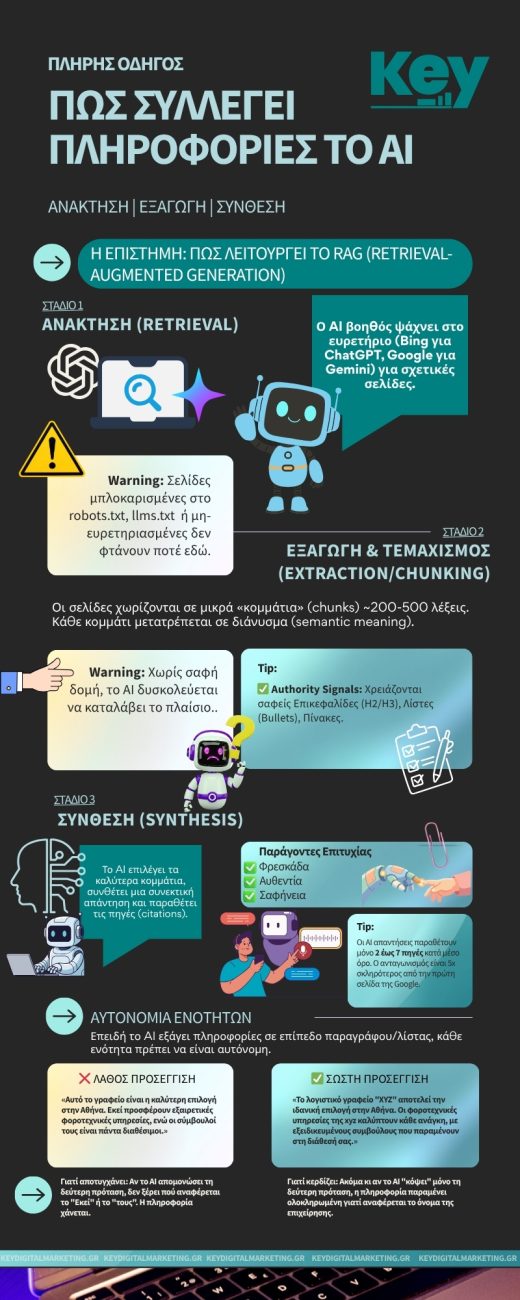
The Pillars of Visibility: How will AI choose you?
You don't have to guess anymore. Data from 2025 and early 2026 shows that artificial intelligence (ChatGPT, Gemini, Perplexity) have specific "taste". If you want to stop being invisible, you must apply the following strategies:
1. Create quick answers (Quick knowledge)
The AI is busy. He doesn't want to look within endless paragraphs to find out what you're doing and what you're offering.
- Tip: Start every section of your page with a clear, direct response of 2-3 sentences.
- The result: Pages with such quick responses show 40% more references to AI responses.
2. Provide specific information that includes numbers and data.
Stop saying, “We have a lot of happy customers.” The AI loves this information.
- Tip: Write "we have completed 70+ projects in the X service sectors with a 98% satisfaction rate".
- Science: The use of specific statistics and primary data increases your visibility by 30-40%. (Did you see what I did here?)
3. Schema Markup: The Language That Bots Speaks
Imagine Schema Markup like the tags on a supermarket's products. It helps AI understand immediately if you're a business, if you have FAQ (Frequently Asked Questions from Customers) or if you're offering a specific service. The right technical infrastructure can boost your presence, as AI doesn’t have to guess who you are.
4. Don't forget Bing (Yes, you read that right)
Google may be the dominant one, but ChatGPT is reading the world through Bing.
- Factuality:87% of SearchGPT sources is identified with Bing's top results. If you show up there, you already have the ticket for ChatGPT's answer.
The Foundations: Technical Specifications and Indexing for LLM Machines
Πριν ξεκινήσεις τη βελτιστοποίηση του περιεχομένου, πρέπει να βεβαιωθείς ότι τα «ρομπότ» της Τεχνητής Νοημοσύνης έχουν ελεύθερη πρόσβαση στις σελίδες σου. Πολλές ιστοσελίδες μπλοκάρουν άθελά τους τα LLM bots μέσω παρωχημένων κανόνων στο αρχείο robots.txt.
1. Open the 'gate' to AI Bots
Make sure the robots.txt file allows access to the most important crawlers. Copy and add the following commands:
User-agent: GPTBot
Allow: /
User-agent: ClaudeBot
Allow: /
User-agent: OAI-SearchBot
Allow: /
User-agent: PerplexityBot
Allow: /
User-agent: Googlebot
Allow: /
2. Secure Indexing
ChatGPT uses OAI-SearchBot for real-time information – if you block it, you’re left off the platform. Respectively, Gemini cannot mention pages that are not already in Google's index.
- Tip: Insert your sitemap to Webmaster Tools of Google and Bing.
3. Speed and Clean Code
The AI has no patience. PerplexityBot, for example, stops reading if the page is late.
- Speed: Maintain response time under 2 seconds.
- Accessibility: AI bots are struggling with JavaScript. Make sure that important information is visible in HTML form (Server-Side Rendering). A good test? Disable JavaScript in your browser—what you see, it also sees AI.
4. The new model: llms.txtstong>
A new trend that is gaining ground is the creation of a llms.txt file. Although optional, it acts as a "map" of instructions specifically for AI models, directing them to your more authoritative and quality content.
So you're telling me that in order for the robot to find me, I have to write as one?
And yes and no. I give you practical advice to increase your visibility in the answers that AI gives, but if you've been following me for a long time, you know I swear on one thing: every piece of content you create must have its own purpose.
This means that you can optimize some pages “technically” for AI, but others, such as your articles, you have to keep them authentic, writing in your own unique way. Never forget: you're addressing people. It delve into your topics at the level that is really useful to your readers and technology will follow. Read how we help you get specialized help in SEO services.